Cold Fusion: The Early Years (1989–1991)
1. Two chemists and a quiet experiment
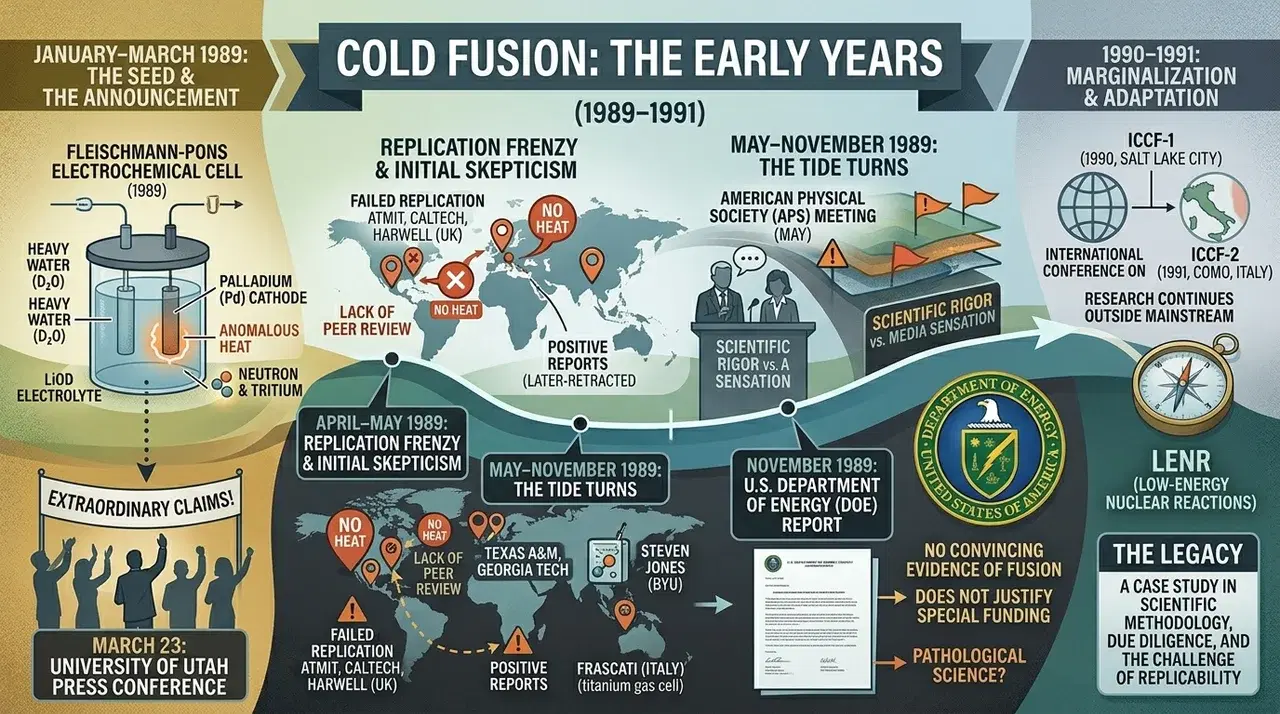
The story does not begin in 1989 but some five years earlier, in the private and largely self-funded work of two electrochemists. [[Martin Fleischmann]], approaching sixty-two, was a Fellow of the Royal Society and one of the most respected electrochemists of his generation, a professor at the [[University of Southampton]]. [[Stanley Pons]], forty-six, chaired the chemistry department at the [[University of Utah]] and had taken his doctorate under Fleischmann at Southampton. Their credentials mattered: as Eugene Mallove later wrote, "were it not for their solid scientific credentials … Fleischmann and Pons would have been roundly laughed out of court."1
Their apparatus was almost provocatively simple — a [[palladium]] cathode and a [[platinum]] anode immersed in [[heavy water]] (D₂O) with a little [[lithium deuteroxide]], driven by a low-voltage current. The premise was that electrolysis would force [[deuterium]] into the palladium lattice at enormous effective pressures, and that something nuclear might follow. One episode around 1985 — a cell that, running unattended, apparently melted part of its electrode and gouged a hole in the laboratory floor — convinced them they were seeing more than chemistry.2 By the summer of 1988, Fleischmann was sufficiently persuaded to write to the [[U.S. Department of Energy|DOE]]'s [[Ryszard Gajewski]] that "we don't think this work should be published," citing possible defence implications.3
2. The announcement, 23 March 1989
What changed everything was not a paper but a press conference. On 23 March 1989, the University of Utah convened the world's media under a release headed "Simple Experiment Results in Sustained N-Fusion at Room Temperature for First Time." At the podium Pons declared that "much more energy is coming out than we are putting in."4
The pair claimed three signatures of a nuclear process: [[excess heat]] — power out exceeding power in, in one case fourfold, "so large that it can only be attributed to a nuclear process"; [[neutron]] emission at roughly three times background; and [[tritium]] above natural background, attributed (with the neutrons) to "side reactions."5 Even at the moment of disclosure the internal tension was visible: the heat was enormous, yet the nuclear by-products were feeble — far too low for the heat, had this been ordinary fusion. Fleischmann urged the world to wait for the literature; the world did not.
3. The other claimant and the priority race
Unknown to most of the public, Utah was not alone. At [[Brigham Young University]], the physicist [[Steven E. Jones]] — a veteran of [[muon-catalyzed fusion]] — had since 1986 pursued a quieter hypothesis with geophysicist [[Paul Palmer]]: that fusion compressed within metal lattices ("[[piezonuclear fusion]]") might explain anomalous [[helium-3]] in volcanic gases. Jones looked not for heat but for low-level neutrons, and reported a modest but real excess.6
The two groups had collided through the DOE grant system: Jones had received the Fleischmann–Pons proposal to review in September 1988, and the Utah side later alleged their ideas had been taken. An agreement to submit papers simultaneously to [[Nature (journal)|Nature]] had been brokered — and then collapsed when Utah staged its press conference and mailed its paper unilaterally. Frank Close's forensic reconstruction concludes the BYU programme was independently conceived and documented from 1986.7 The lasting damage was conceptual: the press fused two very different claims — Jones's small neutron signal with no heat, and Pons–Fleischmann's large heat with no commensurate nuclear products — into one ambiguous story that neither group fully owned.
4. The replication frenzy
For a few weeks in spring 1989, laboratories worldwide dropped their work to reproduce a tabletop experiment described mainly through a press release. The results split sharply and never fully converged. On the positive side, [[Bruce E. Liebert]] at the [[University of Hawaii]] reported large excess heat; [[Eiichi Yamaguchi]] and Takashi Nishioka at [[NTT Basic Research Laboratories]] reported neutron bursts; [[Edmund Storms]] and Carol Talcott at [[Los Alamos National Laboratory]] found tritium in a fraction of their cells; [[Francesco Scaramuzzi]] at [[Frascati]] reported neutron bursts from titanium in deuterium gas; and the [[Bhabha Atomic Research Centre]] in India reported neutrons and tritium from the very first day of experiments.8 Against these, groups at the [[Joint Institute for Nuclear Research]] and in Italy, France and the United States set upper limits on neutron emission orders of magnitude below the claims.9 The defining problem was not that no one saw anything, but that no one could see it reliably.
5. The skeptical demolition
Through April and May 1989 the institutional tide turned hard. A [[California Institute of Technology]] team — electrochemist [[Nathan Lewis]], nuclear physicist [[Charlie Barnes]], theorist [[Steven Koonin]] — spent four weeks attempting replication, found nothing, and delivered a devastating critique at the [[American Physical Society]] meeting in Baltimore on 1 May 1989; Lewis argued the largest "excess power" figures may have been calculated rather than measured.10 In Britain, [[Harwell]] — with Fleischmann's own collaborator [[David Williams]] leading a large, well-resourced effort — reported entirely null results and withdrew in June 1989.11 A persistent sub-controversy concerned whether Utah had ever performed the crucial light-water control experiment. The mood curdled further when Pons's attorney threatened the Utah physicist [[Michael Salamon]] with legal action over a null-result paper in Nature — an episode many scientists read as antithetical to open inquiry.12
6. The official verdict: ERAB
Washington responded institutionally. On 24 April 1989 DOE Secretary James Watkins directed the [[Energy Research Advisory Board]] to convene a 23-member panel, co-chaired by the skeptic [[John Huizenga]] (Rochester) and the new Nobel laureate [[Norman Ramsey]] (Harvard). Its November 1989 report concluded that the evidence for a new nuclear process was "not persuasive," recommended against any dedicated program or center, but left a much-quoted escape clause: "some observations attributed to cold fusion are not yet invalidated."13 That hedge owed much to Ramsey, who — dissatisfied with Huizenga's blanket negativity — threatened to resign unless a softening preamble was added, conceding that "it is not possible at this time to state categorically that all the claims for cold fusion have been either convincingly proved or disproved."14 The practical effect was immediate: federal money evaporated, including a $2 million cut to the very DOE division that had signalled interest.15 The [[New York Times]] reported the verdict under "Panel Doubts Cold Fusion Research Will Pay Off on Energy," quoting Huizenga: "The present evidence for a new nuclear fusion process is just not persuasive."16
7. Entrenchment, not resolution
What is striking about the early years is that the controversy did not end — it bifurcated. Utah's legislature voted $5 million and the state established the [[National Cold Fusion Institute]] under [[Fritz G. Will]] in its Research Park; the institute soon foundered amid an "anonymous donor" scandal that contributed to the retirement of university president [[Chase Peterson]].17
The [[First Annual Conference on Cold Fusion]] (Salt Lake City, 28–31 March 1990) crystallised the split. Some 230 researchers heard Pons report excess power of 75–112 watts per cubic centimetre of palladium; [[John O'M. Bockris]] of [[Texas A&M University]] present tritium near a million times background; and the Nobel laureate [[Julian Schwinger]] declare that "it is no longer possible to lightly dismiss the reality of cold fusion."18 On the very day it opened, Nature ran an editorial titled "Farewell (Not Fond) to Cold Fusion," and the APS's [[Robert L. Park]] dismissed the gathering as "a seance of true-believers."19
Tritium became the bitterest battleground. The Texas A&M data were among the most dramatic — and the most attacked. In June 1990 [[Kevin Wolf]] retracted his own tritium results, citing possible contamination, and [[Gary Taubes]] published a Science article alleging possible fraud; Mallove's rebuttal held that the charges were circumstantial and ignored tritium reports from more than a dozen independent groups.20 Neither side persuaded the other.
8. What the early years settled — and didn't
By 1991 the field had reached the shape it would keep for a generation. The mainstream physics community, anchored by the ERAB report and the failed high-profile replications, regarded cold fusion as a closed case of error. A transnational network of chemists and a few physicists — sustained by the ICCF conference series, newsletters such as [[Fusion Facts]], and later the rebranding to [[LENR]] — continued to report excess heat, tritium, and helium, insisting the phenomenon was real but stubbornly irreproducible on demand.21
The early years are best understood not as the rise and fall of a discovery but as the birth of a permanent schism. The original sin was procedural — science by press conference, before the controls were nailed down and before the heat and the nuclear products could be reconciled. That single mismatch, between an enormous claimed energy and an almost-absent nuclear signature, was never resolved in this period.
Notes
References
- Synthesized from the cold-fusion source archive (Fusion Facts newsletter and books): Mallove, Fire from Ice (1991); Close, Too Hot to Handle (1992); Sutton, Cold Fusion: The Secret Energy Revolution (1999); and Fusion Facts (Fusion Information Center, 1990–1996).
Footnotes
-
Eugene F. Mallove, Fire from Ice: Searching for the Truth Behind the Cold Fusion Furor (New York: John Wiley & Sons, 1991), Pt. 3 (pp. 41–60). On the experimenters' backgrounds, see also Frank Close, Too Hot to Handle: The Race for Cold Fusion (London: Penguin Books, new ed. 1992). ↩
-
Mallove, Fire from Ice, Pt. 3; the melting/explosion episode (c. 1985) was also described by Fleischmann at the 23 March 1989 press conference ("the melting point of palladium is 1569 degrees centigrade … we didn't want to believe that we had ignition"). ↩
-
Mallove, Fire from Ice, Pt. 3. Fleischmann's summer-1988 letter to [[Ryszard Gajewski]] of the DOE. ↩
-
University of Utah press release, "Simple Experiment Results in Sustained N-Fusion at Room Temperature for First Time," 23 March 1989; Pons's remarks quoted in Mallove, Fire from Ice, Pt. 3. See [[Fleischmann-Pons announcement]]. ↩
-
University of Utah press release, 23 March 1989; figures (excess power 5–50% of input; 5–111% over resistive heating) per Mallove, Fire from Ice, Pt. 3 (pp. 41–60) and Pt. 12 (pp. 221–240). ↩
-
Close, Too Hot to Handle, Pt. 4 (pp. 61–80) and Pt. 8 (pp. 141–160); Mallove, Fire from Ice, Pt. 9 (pp. 161–180). On the Jones–Palmer origin (BYU colloquium, 12 March 1986) and the coining of "piezonuclear fusion." ↩
-
Close, Too Hot to Handle, Pt. 4 and Pt. 8: Jones received the Fleischmann–Pons DOE proposal for review in September 1988; the agreed simultaneous Nature submission collapsed when Utah announced unilaterally on 23 March 1989. Close concludes the BYU programme was independently conceived and documented from 1986. ↩
-
Fusion Facts (Fusion Information Center, Salt Lake City), Vol. 2, Issue 1 (July 1990); and the Proceedings of the First Annual Conference on Cold Fusion (NCFI, 1990). Liebert (Hawaii), Yamaguchi & Nishioka (NTT), Storms & Talcott (Los Alamos), Scaramuzzi (Frascati), and BARC (India). ↩
-
Fusion Facts, Vol. 2, Issue 1 (July 1990); Mallove, Fire from Ice, Pts. 12–13. Negative neutron limits from the [[Joint Institute for Nuclear Research]] and Italian, French, and US groups. ↩
-
Close, Too Hot to Handle, Pt. 10 (pp. 181–200) and Pt. 11 (pp. 201–220); Mallove, Fire from Ice, Pt. 5 (pp. 81–100). The Caltech team (Lewis, Barnes, Koonin) at the APS meeting, Baltimore, 1 May 1989. ↩
-
Close, Too Hot to Handle, Pt. 11 and Pt. 16 (pp. 301–320). The [[Harwell]] (UKAEA) replication led by [[David Williams]]; withdrawal announced June 1989. ↩
-
Mallove, Fire from Ice, Pt. 13 (pp. 241–260); Close, Too Hot to Handle. The April 1990 legal threat to [[Michael Salamon]] via attorney C. Gary Triggs over his null-result paper in Nature. ↩
-
Energy Research Advisory Board, Cold Fusion Research (Report to the U.S. Department of Energy, November 1989); Mallove, Fire from Ice, Pts. 9–11 and Pt. 17 (pp. 321–340); Close, Too Hot to Handle, Pt. 13 (pp. 241–260). Watkins's directive to ERAB chair John Schoettler, 24 April 1989; report approved 26 November 1989. ↩
-
Mallove, Fire from Ice, Pt. 17. The [[Norman Ramsey]] preamble and his threatened resignation over [[John Huizenga]]'s draft conclusions. ↩
-
Mallove, Fire from Ice, Pt. 11; Antony C. Sutton, Cold Fusion: The Secret Energy Revolution (1999), Pt. 1 (pp. 1–20). The $2 million removed from FY1990 funding of the DOE Division of Advanced Energy Projects. ↩
-
New York Times, "Panel Doubts Cold Fusion Research Will Pay Off on Energy" (November 1989), as quoted in the ERAB report's reception and in Mallove, Fire from Ice, Pt. 11. ↩
-
Mallove, Fire from Ice, Pts. 5 and 13; Close, Too Hot to Handle, Pts. 11 and 16. Utah's $5M appropriation; the [[National Cold Fusion Institute]] under [[Fritz G. Will]]; the anonymous-donor episode and President [[Chase Peterson]]'s retirement. ↩
-
Proceedings of the First Annual Conference on Cold Fusion (NCFI, 1990); Mallove, Fire from Ice, Pt. 13 (pp. 241–260); Fusion Facts, Vol. 2, Issue 1 (July 1990). Pons's 75–112 W/cm³ figure; [[John O'M. Bockris]]'s Texas A&M tritium data; Schwinger's evening address. See [[First Annual Conference on Cold Fusion]]. ↩
-
Nature, "Farewell (Not Fond) to Cold Fusion," editorial, 29 March 1990; [[Robert L. Park]] (American Physical Society) quoted in contemporaneous press and in Mallove, Fire from Ice, Pt. 13. ↩
-
Mallove, Fire from Ice, Pt. 13; Gary Taubes, "Cold Fusion Conundrum at Texas A&M," Science (1990). [[Kevin Wolf]]'s June 1990 retraction citing possible palladium contamination ([[Hoover and Strong, Inc.]]); Mallove's rebuttal of the Taubes fraud allegations. ↩
-
Fusion Facts, various issues 1990–1996 (Vol. 2, Issue 12, June 1991; Vol. 6, Issue 6, December 1994); on the migration to the [[LENR]] label and the ICCF conference series. ↩
Related Articles
Edmund Storms' Cold Fusion History: An Anticipated LENR Perspective
Anticipate a unique historical deep-dive as LENR pioneer Edmund Storms shares his authoritative perspective on cold fusion in an upcoming LENR News feature.
Buying an emerging technology: A Due-Diligence Guide from the History of Cold Fusion
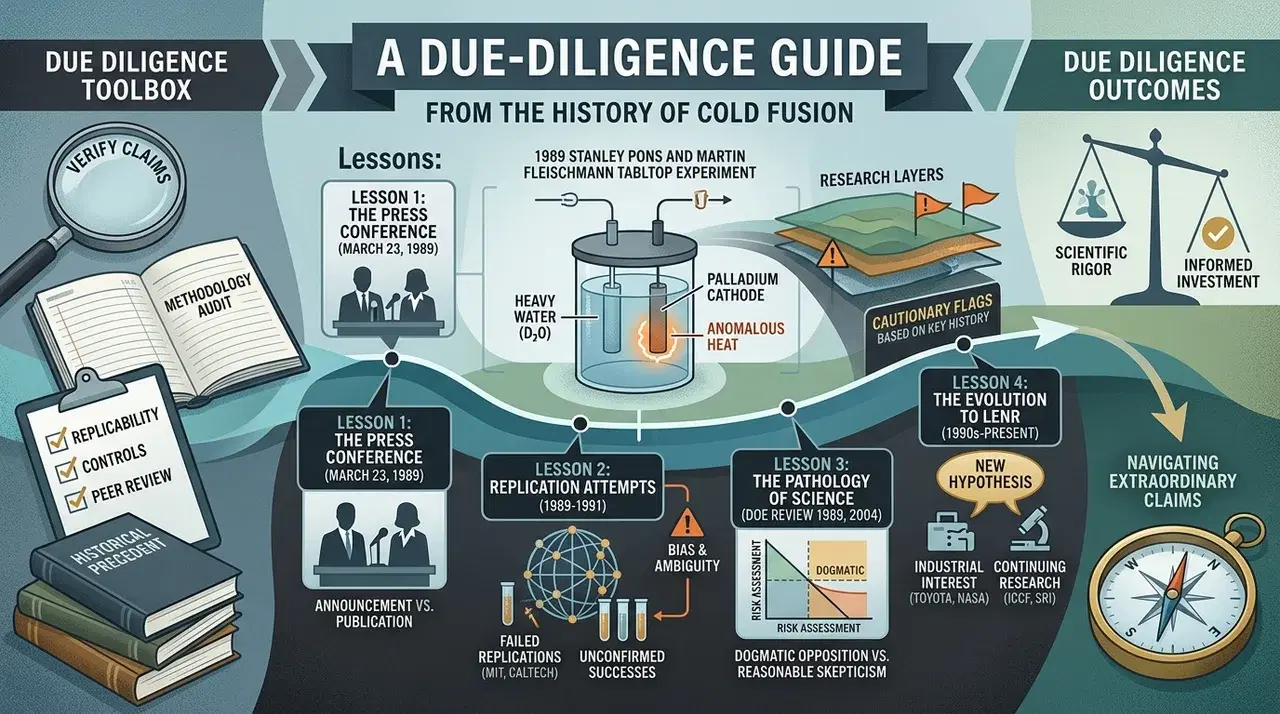
For as long as people have claimed to sell devices that produce more energy than they consume, the claims have shared a recognisable shape. A buyer does not need to adjudicate the underlying physics — a question the scientific community itself has not closed — to protect themselves. They need to ask the questions that skeptics and disappointed investigators have been asking since the [[Fleischmann-Pons announcement]] of March 1989. This guide distils those questions into a due-diligence framework drawn entirely from the historical record: how excess-energy *measurements* go wrong, what independent *reproduction* actually requires, what a hollow *demonstration* looks like, and what past *commercial* devices teach about the gap between a showroom and a working product.
LENR Ontology Update v8: Standardizing Cold Fusion Research
A significant update to the "Corrected Ontology related to Cold Fusion" (v8) marks a crucial step towards standardizing LENR research and accelerating development.